
Why answer-only prompts fail on multi-step tasks
Recall the core loop: the model writes one token at a time, and each token is conditioned on everything before it. If you ask only for a final number, the model must produce that number immediately, with no intermediate tokens to build on. If the task really requires intermediate results, such as filtering a list, adding the remainder, and dividing, the model has to compress all of it into one guess. [source]
The research
In January 2022, Google researchers showed that giving a model worked examples that spell out intermediate steps, and then asking a new question, led the model to show its own steps and substantially improved accuracy on arithmetic, common-sense, and symbolic reasoning tasks. [source] In May 2022, researchers from the University of Tokyo and Google showed that examples were not even necessary: adding "Let's think step by step" before the answer produced large gains on the same kinds of tasks. [source] A related technique, self-consistency, samples several independent reasoning paths and takes the most common final answer. [source]
A worked example
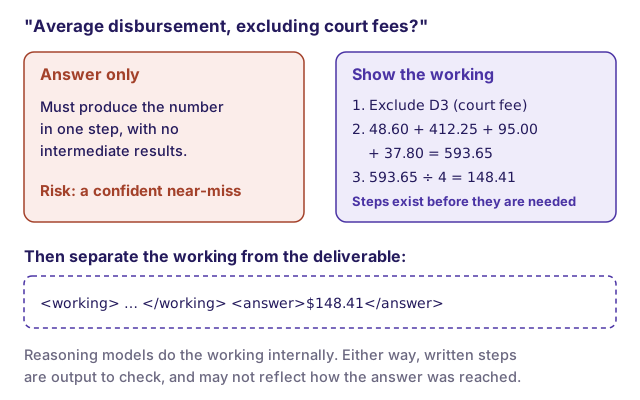
Take a list of disbursements and ask: "What is the average disbursement, excluding court filing fees?"
| ID | Item | Amount |
|---|---|---|
| D1 | Courier | $48.60 |
| D2 | Transcript | $412.25 |
| D3 | Court filing fee | $270.00 |
| D4 | Process server | $95.00 |
| D5 | Photocopying | $37.80 |
The correct answer is $148.41: remove D3, add the other four ($593.65), divide by four. A model asked for only the number has to do the exclusion, the addition, and the division in a single step, and a near-miss is a common result. Asked to list the included items, show the sum, then divide, it has written each intermediate result before it needs it. This is an illustration constructed for this lesson; test your own model on your own tasks rather than relying on a general claim about any one model.
A second example. Ask what this short program prints:
def greet(name):
    return "Hello, " + (name + "!!") * 3 + "!"
print(greet("Ruiz"))
The answer is Hello, Ruiz!!Ruiz!!Ruiz!!!. Answering in one step, a model can easily get the count of exclamation marks wrong. Asked to evaluate the expression piece by piece (the repeated part first, then the join), it has the intermediate string in front of it before writing the final one. [source]
The same pattern helps with tracing a sequence of events, applying a multi-part test, reconciling two schedules, or working out which version of a clause was in force on a date.
Reasoning models changed the advice
Since late 2024, many models are reasoning models. They are trained to generate an internal chain of reasoning before answering, often called extended thinking. [source]
OpenAI's guidance for its reasoning models is to keep prompts simple and direct: because the model already reasons internally, instructions like "think step by step" or "explain your reasoning" are unnecessary and can even hurt. The same guidance suggests trying without few-shot examples first, and adding them only if the output needs a specific form. [source] For these models, the better levers are a clear goal, the right source material, explicit success criteria, and, where the product offers it, a setting for how much reasoning effort to spend.
For models without built-in reasoning, the 2022 techniques remain candidates to test; the original results do not guarantee improvement on a new task.
Separate the deliverable from its verification
Often you want a concise deliverable plus checkable support. Ask for source references, assumptions, and reproducible calculations separately, using tags or structured fields: [source]
Return the answer in <answer> tags.
In <verification>, list the source IDs, assumptions, and calculation needed to check it.
Provide a concise explanation, not private internal reasoning.
or
{"verification": "D1 + D2 + D4 + D5 = 593.65; 593.65 / 4 = 148.4125",
 "answer": "$148.41"}
Keep that verification record when the result matters. It identifies what to check; it does not expose or prove the model’s internal process.
Costs and limits
- Tokens, time, and money. Reasoning consumes tokens, which increases cost and the time before you see an answer. [source] Reasoning tokens also count toward the context window. [source]
- The steps can be wrong. Each written step is generated text. A clean chain of steps can contain a false premise, a misread document, or an arithmetic error.
- The steps may not be the real process. Anthropic's 2025 research found that reasoning models often did not mention, in their visible reasoning, hints that had in fact influenced their answers. [source] Treat displayed reasoning as a useful map of where to check, not as an audit trail of how the conclusion was reached.
For anything that matters, verify the inputs and recompute the critical steps independently. For arithmetic in particular, a spreadsheet or script is more reliable than any language model.